Podcast Editing Services for Audio and Video Shows
You record. We cut, clean, mix and master every episode to the loudness your platform actually uses — then hand it back ready to publish.
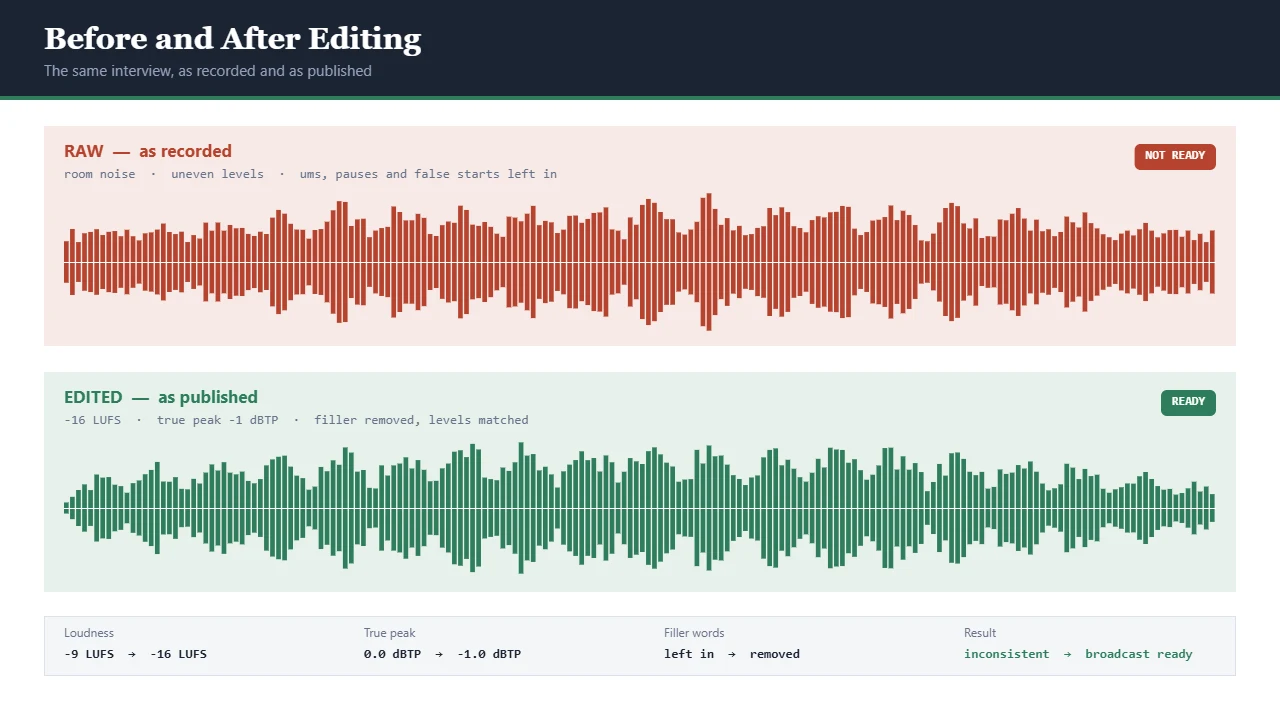
Noise, filler words, false starts, long pauses and uneven levels all go. If your show has a camera, the picture is cut to the same edit so sound and vision never drift. Send one episode and we will tell you exactly what it needs and what it costs.
What podcast editing includes
Six stages on every episode. Most services stop after the first two and call it editing.
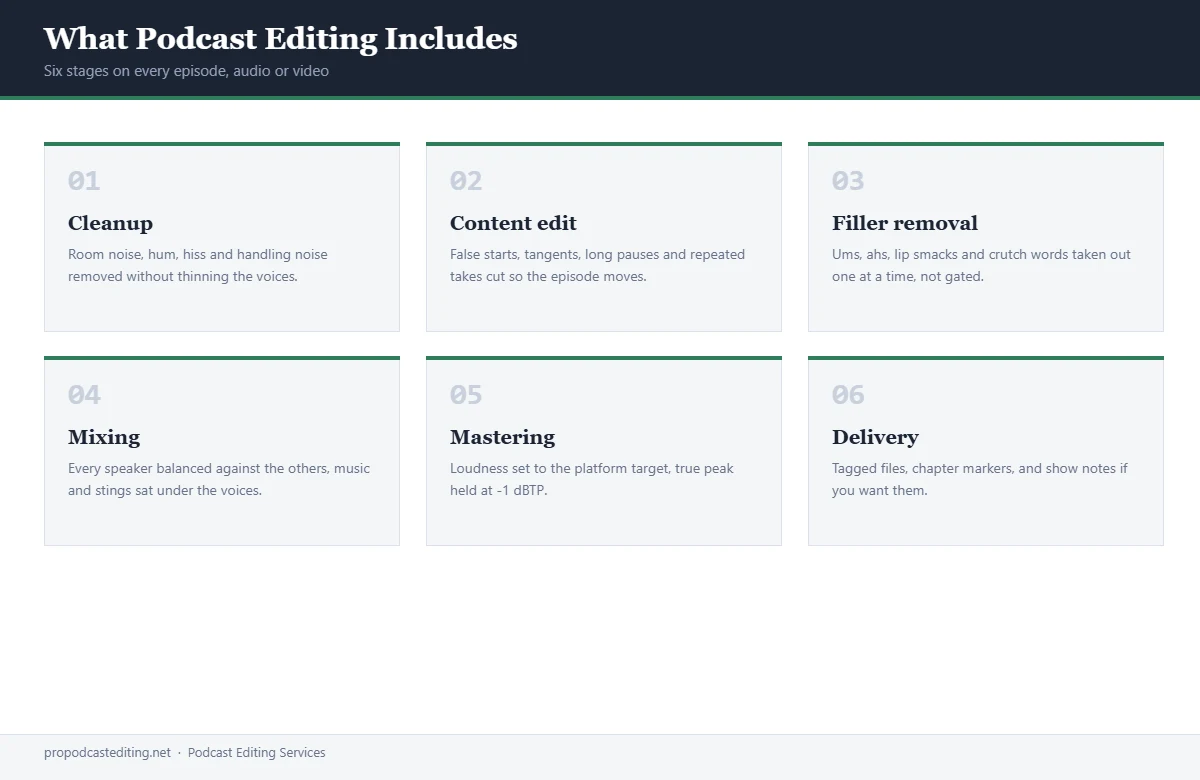
Cleanup
Room tone, computer hum, hiss, chair creaks and handling noise removed with spectral repair rather than a blanket noise gate, so voices keep their body instead of going thin and underwater.
Content edit
False starts, tangents that go nowhere, repeated takes and dead air cut so the episode actually moves. This is editorial judgement, not waveform trimming — we listen to the whole thing.
Filler removal
Ums, ahs, lip smacks and crutch words taken out individually. Done badly this leaves speech sounding clipped and breathless; done properly you cannot hear that anything was removed.
Mixing
Every speaker balanced against the others, so the quiet guest and the loud host sit at the same level. Music, stings and ad reads placed under the voices rather than fighting them.
Mastering
Loudness set to the platform target and true peak held at −1 dBTP. The table further down explains why this single number matters more than most people realise.
Delivery
Correctly tagged files in the format your host wants, chapter markers where useful, and show notes and timestamps if you want them written too.
Also available: intro and outro assembly, ad insertion, transcripts, and audiogram clips for social. If you publish books as well as episodes, our audiobook editing service runs through the same studio.
Video podcast editing
A video show is not an audio show with a camera pointed at it. The two edits have to agree, frame for frame.
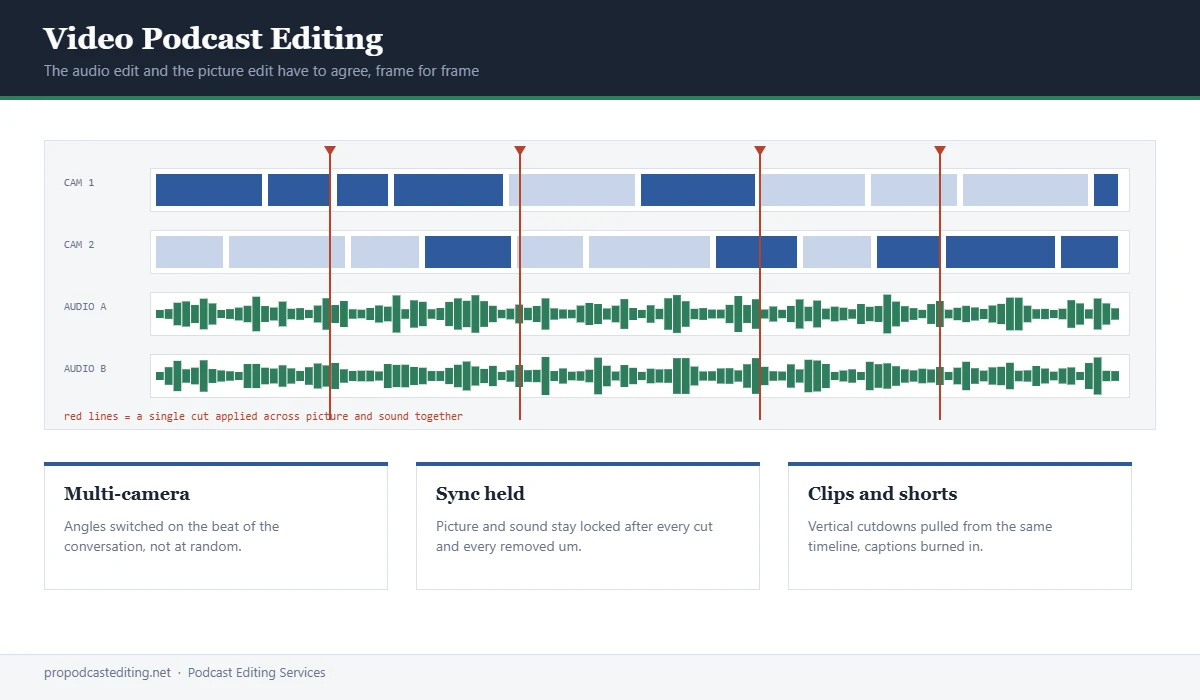
Every um you remove from the audio leaves a hole in the picture. Every camera switch has to land where the conversation turns, not on a timer. Get this wrong and viewers feel it even when they cannot name it — the show looks slightly off, and they leave.
We cut picture and sound on the same timeline, so the audio edit and the video edit are one decision rather than two jobs handed between people.
What this covers
- Multi-camera switching timed to the conversation
- Sync held through every cut and every removed filler word
- Colour and exposure matched between angles
- Separate mic tracks mixed, not just camera audio
- Vertical cutdowns and shorts from the same timeline
- Burned-in captions where you want them
The loudness your platform actually uses
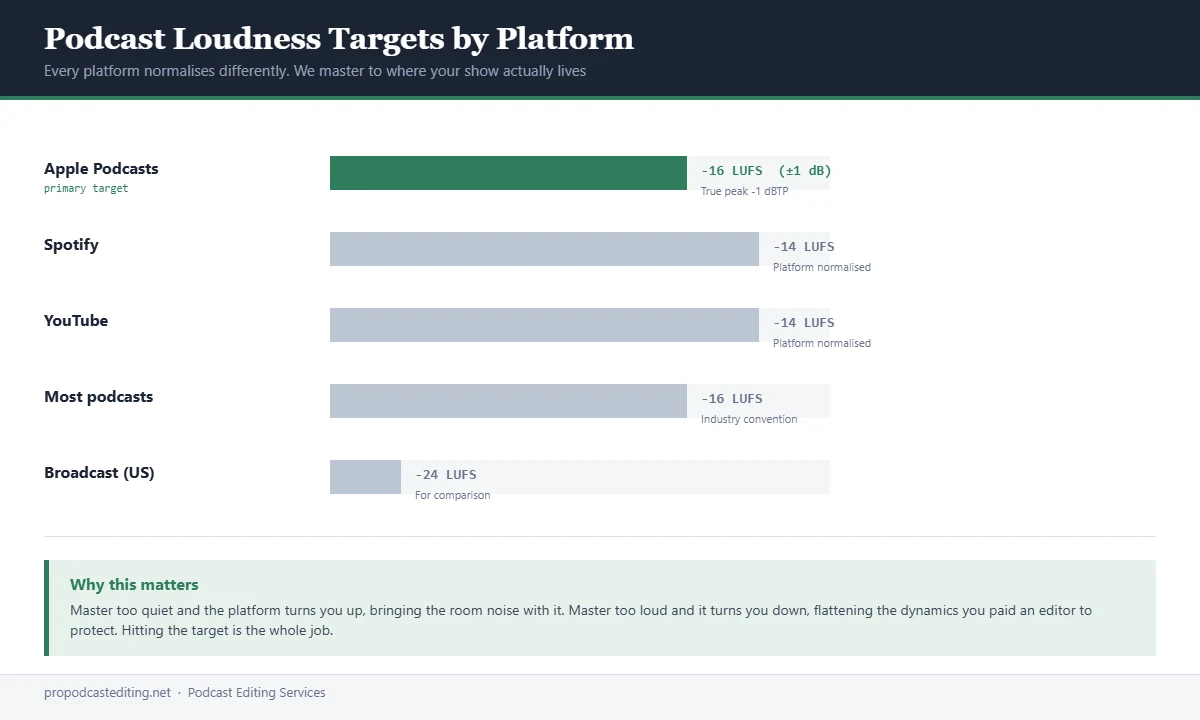
Every platform normalises your episode on playback. Mastering to the wrong number is the most common reason a professionally edited show still sounds amateur.
| Platform | Loudness target | Notes |
|---|---|---|
| Apple Podcasts | −16 LUFS (±1 dB) | True peak must not exceed −1 dBTP |
| Spotify | −14 LUFS | Normalised on playback |
| YouTube | −14 LUFS | Normalised on playback |
| Industry convention | −16 LUFS | Where most podcasts sit |
| Broadcast radio (US) | −24 LUFS | For comparison only |
Apple publishes its requirement in its own audio requirements documentation. We check against the current spec rather than trusting a saved preset.
Why the number matters. Master too quiet and the platform turns your episode up — and brings every bit of room noise up with it. Master too loud and it turns you down, flattening the dynamics you paid an editor to protect. Hitting the target is most of the job.
Show notes and episode prep
Editing gets the episode ready to hear. Show notes get it found. We listen while we edit, so the notes come from the actual conversation rather than a transcript skim.
- Episode summary written to be read, not stuffed
- Timestamped chapters for the moments that matter
- Guest bio, links and anything promised on air
- Titles that say what the episode is about
- Full transcript on request
If you are working out episode length and pacing, our free playback speed calculator is useful for seeing how long your show runs at different listening speeds.
Who this is for
Not everyone needs an editor. You probably do if one of these is true:
- You are spending more hours editing than recording
- Episodes go out late because post-production is the bottleneck
- Your show sounds different week to week
- You record video and audio and are stitching two workflows together
- You have guests whose audio quality you cannot control
- You want the show to sound the same in six months as it does today
If you are still choosing software and want to keep editing yourself, our guide to podcast editing software covers the realistic options.
Podcast editing pricing
We charge $1 per recorded minute. Not per finished minute, not per episode, not a monthly retainer — per minute of the audio you actually send us.
| You send | You pay | What is included |
|---|---|---|
| 30 minutes recorded | $30 | Full six-stage edit and master |
| 45 minutes recorded | $45 | Full six-stage edit and master |
| 60 minutes recorded | $60 | Full six-stage edit and master |
| 90 minutes recorded | $90 | Full six-stage edit and master |
How that compares
Most of the industry prices by episode or by monthly retainer, which means you do not know the figure until the work is scoped. Here is the market as it stands:
| Pricing model | Typical rate | What it usually covers |
|---|---|---|
| Monthly production retainer | from $499 / month | Full production, fixed episode count |
| Per-episode agency rate | $75 – $150 / episode | Editing and mastering, scoped per show |
| Per published minute | around $0.40 / min | Often largely automated |
| Pro Podcast Editing | $1.00 / recorded min | Six-stage edit, mastered to platform target |
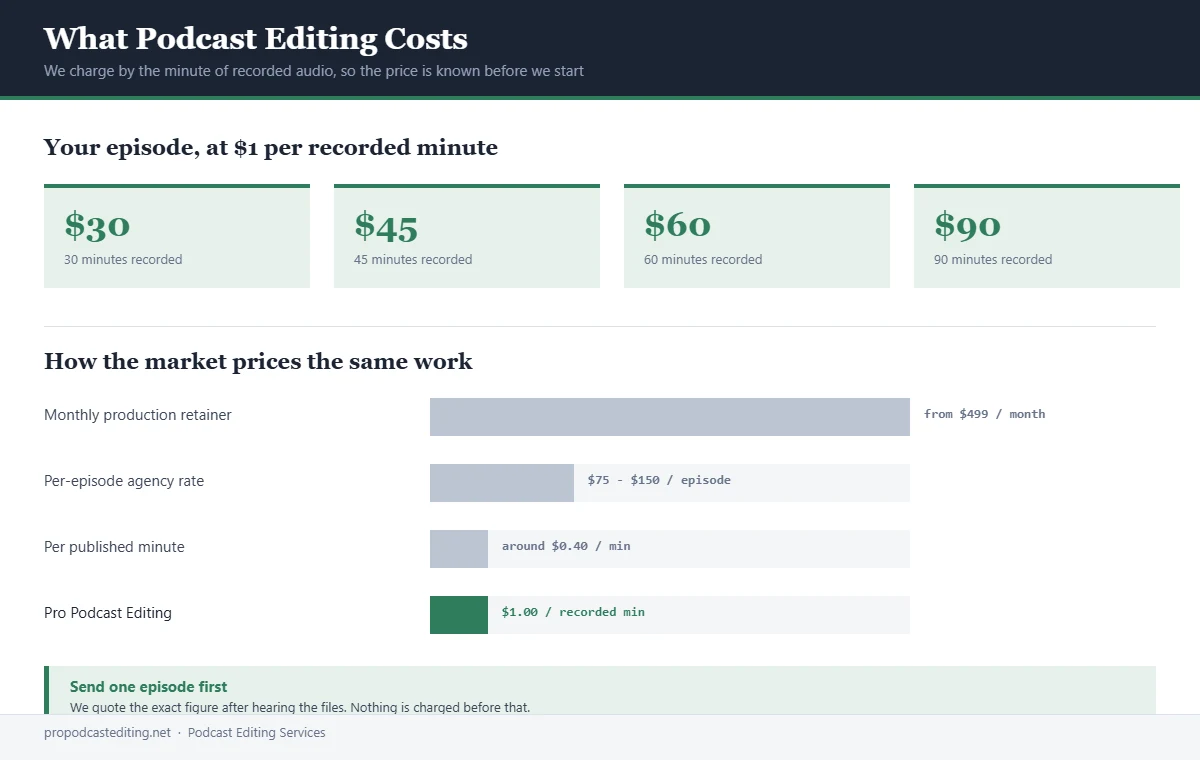
Video, heavy cleanup and rush turnaround are quoted separately. We cannot name an exact figure until we have heard the files, because a clean two-mic interview and a noisy four-person round table are not the same job. Send one episode and the quote is fixed before anything is charged.
What editing can fix, and what it cannot
Worth saying plainly, because most services will not.
Fixable
- Steady background noise — fans, air conditioning, traffic rumble, computer hum
- Ums, ahs, lip smacks, plosives and heavy breaths
- Levels that differ between speakers, or between episodes
- Long pauses, false starts, tangents and repeated takes
- Loudness and true peak outside the platform target
- Light to moderate room reflection
Not fully fixable
- Heavy room echo. Reverb is recorded into the file. It can be reduced, never removed, and pushing harder leaves voices sounding hollow.
- Clipped or distorted audio. If the signal was recorded too hot, that information is gone for good.
- Bad connection audio. A guest on a dropping video call gives you artefacts, not just noise. We improve it; we cannot invent what was never captured.
- A conversation that did not work. Editing tightens a good conversation. It does not create one.
This is why we ask for one episode first. It tells us whether your setup needs changing before you record a whole season, and that check costs nothing.
How it works
Send one episode
Raw files, however they came off your recorder. We listen to the whole thing before quoting.
Get a fixed quote
Price, turnaround and exactly what we will do. Nothing is charged before you agree.
Upload your files
Google Drive, Dropbox or WeTransfer. Separate mic tracks preferred if you have them.
First edit back
You hear the first episode early, so the style is agreed before we work through the rest.
Mix and master
Levels balanced, loudness set to your platform target, true peak checked.
Delivery
Tagged files ready to upload, plus show notes and chapters if you asked for them.
What to send us
The more separate the tracks, the better the result. In order of preference:
- Separate WAV per microphone — lets us fix one speaker without touching another
- Separate tracks from your recording platform — most remote recorders export these
- A single mixed WAV — still fine, just less room to work
- MP3 — we will work with it, though some damage is already baked in
For video, send the camera files and the audio separately rather than the camera’s own sound. We will sync them.
What our clients say
Hosts, founders and studios whose shows go out through this studio every week.
Complete peace of mind
Handing over our show to this team was the best decision. From detailed audio cleanup to polished video delivery, everything was handled professionally. The workflow was smooth, communication was clear, and deadlines were always met.
 Alex ThompsonFounder – HealthTalk Network
Reliable and consistent quality
We were looking for a long-term editing partner, not just a one-time service. This team understood our format, improved clarity, and delivered every episode with the same high standard. The improvement in sound balance was noticeable from the first release.
 Sarah WilliamsCEO – Growth Minds Media
A professional production team
Our raw recordings were transformed into clean, watchable episodes. The team focused on details we did not even notice before, especially background noise and pacing. The final output looks polished and performs better across platforms.
 Daniel RobertsCo-Founder – Startup Voice Studio
Saved us time and stress
Managing post-production was slowing us down. After working with this team, we could fully focus on content creation while they handled everything else. Each episode now feels structured, professional, and audience ready.
 Emily CarterHost – The Modern Creator Show
We also edit audiobooks
If you narrate your own book as well as hosting a show, the same studio handles it. Audiobook work has its own technical bar — ACX measures RMS, peak and noise floor automatically, and a file outside the range is rejected before a human hears it.
Proof listening against your manuscript, editing, mastering to ACX spec, and rejection fixes if Audible has already sent your book back.
Frequently asked questions
The questions hosts ask us most often.
How much does podcast editing cost?
We charge $1 per recorded minute, so a 45-minute recording costs $45. That covers the full six-stage edit and mastering to your platform’s loudness target.
Video editing, heavy restoration work and rush turnaround are quoted separately, because a clean two-mic interview and a noisy four-person round table are genuinely different jobs. Send one episode and we fix the price before anything is charged.
Do you edit video podcasts as well as audio?
Yes, and we treat them as one job rather than two. Picture and sound are cut on the same timeline, so sync holds through every edit, including every removed filler word. Multi-camera switching, colour matching between angles, vertical cutdowns and burned-in captions are all covered.
How long does editing take?
A standard audio episode comes back within two to three working days. Video and multi-speaker episodes take longer, usually four to five. We always send the first episode back early so you can confirm the style before we work through a batch.
Will you remove filler words like um and ah?
Yes, individually rather than with an automatic gate. The difference matters: automated removal leaves speech sounding clipped and breathless, because it cuts the natural pauses around the word as well. Done properly you cannot hear that anything was taken out.
What loudness do you master to?
−16 LUFS with true peak at −1 dBTP for Apple Podcasts, which is also where most podcasts sit. Spotify and YouTube normalise to −14 LUFS.
If your show lives mainly on one platform we master to that target. If it is everywhere, −16 LUFS is the safe choice, because a platform turning you down costs you less than one turning you up and raising the noise floor with you.
What files should I send?
Separate WAV files, one per microphone, give the best result — it lets us fix one speaker without touching another. A single mixed WAV is fine too. We will work with MP3, though some damage is already baked into the file by then.
For video, send the camera files and the audio recordings separately rather than relying on the camera’s own sound. We will sync them.
Do you write show notes?
Yes. Episode summary, timestamped chapters, guest bio and links, and title suggestions. Because we listen to the full episode while editing, the notes come from the actual conversation rather than a skim of an automated transcript. Full transcripts are available on request.
Can you fix a bad recording?
Partly, and we will tell you honestly which part. Steady background noise, uneven levels and room hum are all fixable. Heavy echo can be reduced but never removed, and clipped or distorted audio cannot be recovered at all — that information is gone.
Send a sample before committing to a season and we will say plainly what your setup needs.
Do you work on an ongoing basis or one episode at a time?
Either. Many shows start with one episode, confirm the style, and then send every week. There is no contract and no minimum episode count.
Do you also edit audiobooks?
Yes. Audiobook editing runs through the same studio, including proof listening against the manuscript and mastering to ACX and Audible technical standards. Authors who also host a show often keep both in one place.
More from the studio
Guides, tools and the other services we run.
Send us one episode
We will listen to the whole thing, tell you what it needs, what it costs and how long it takes. No obligation, and nothing charged until you agree the quote.